Language is cumulative, and so is the gap.
So, what do Readers (with a capital R) need to comprehend deeply? At least 8 things.
And it turns out Writers, Listeners, and Speakers share many of the same conditions.

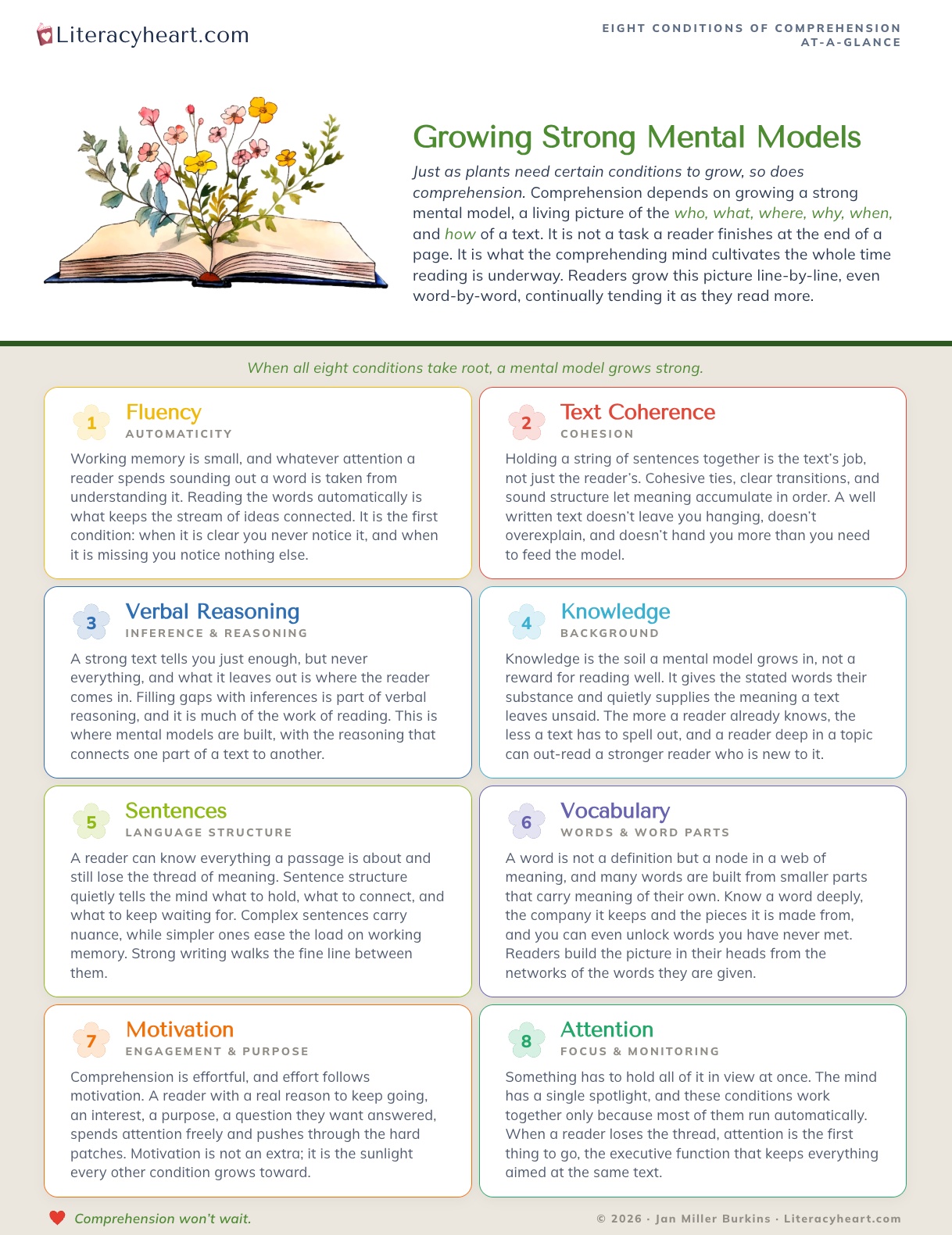
8 Conditions for Comprehension
Get a little love in your inbox. Unsubscribe anytime.
They look, and even sound, fine because they can read the words, but they aren’t actually “reading” the words because they aren’t comprehending.

Reading Comprehension doesn’t just fall into place. Children who spend years pulling words off the page without practicing building mental models in their heads are not learning to comprehend: they’re actually practicing tuning meaning out.
In first grade, they look fine; they’re learning sound-spellings and how to decode.
By third grade, unexpected problems with comprehension are surfacing.
By fifth, they’ve decided that reading just isn’t for them.
Language comprehension and reading comprehension are both fueled by mental modeling, which is informed by efficient and accurate word reading.
If any one of the three parts is compromised or left out of instruction you may have something that looks like “reading,” but it stops short of the full richness of Reading (with a capital R).
 Reading
Having both parts of the Simple View of Reading isn’t enough. They have to be integrated for Reading (with a capital R) to happen.
Reading comprehension is the product of word reading and language comprehension working together, and there’s an engine running both:
1 Gough & Tunmer (1986). The Simple View of Reading. Reading comprehension = Decoding × Language Comprehension. The mental model a reader builds, what Kintsch (1988) called the “situation model,” is the reading-specific form of an idea that traces to Craik (1943) and Johnson-Laird (1983).
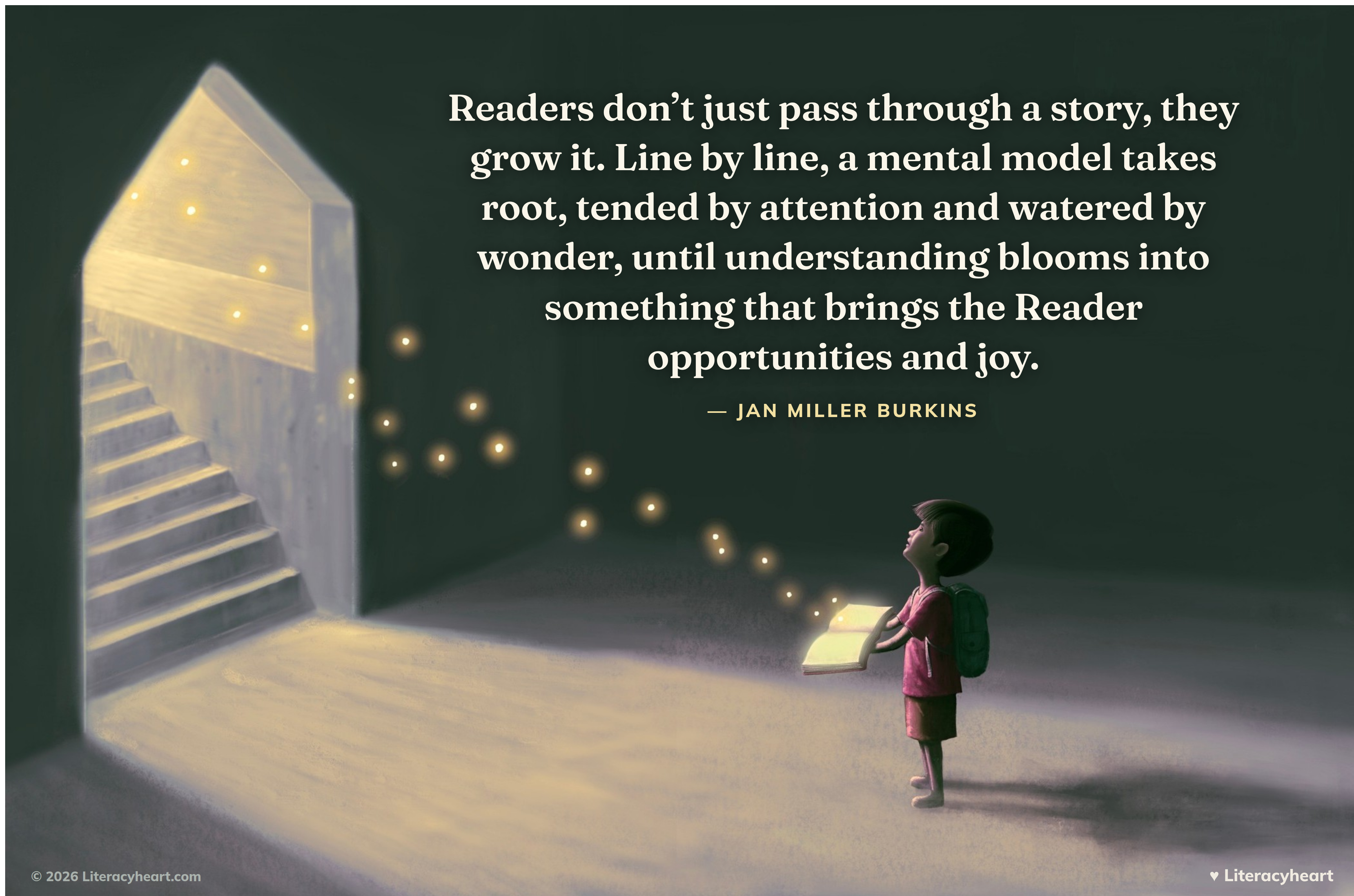
“Readers don’t just pass through a story, they grow it. Line by line, a mental model takes root, tended by attention and watered by wonder, until understanding blooms into something that brings the Reader opportunities and joy.”
Jan Miller Burkins
Comprehension is not a skill you teach, it’s what happens when an assortment of interacting processes engage at once, fast enough to be seamless. Let go of any one of them and comprehension gets compromised.1 So, what do readers need to comprehend written text?
Fluency
Decoding so automatic it no longer registers as work. Until word recognition runs below the level of conscious attention, there is nothing left over to think with. Fluency is the price of admission to meaning.
Coherence
Meaning doesn’t stop at the period. Pronoun references, transitions, and structure bind separate sentences into a whole. You can understand every sentence and still lose the thread.
Verbal Reasoning
The text says less than it means, on purpose. Inference, metaphor, and irony are where comprehension turns into insight: reading across the lines, not just along them.
Knowledge
You cannot comprehend what you have no schema for. The more a reader already knows about the world, the less the text has to spell out, and the more it can mean.
Sentences
Syntax, morphology, and the architecture of meaning. Knowing the words is not the same as knowing how they combine. Structure is what tells you who did what to whom.
Vocabulary
Vocabulary is not a word list but a network of word meanings. Depth, precision, and the dense web of associations behind each word are what let a reader grasp shades of meaning the sentence never states outright.
Motivation
A reader has to want to make meaning. Curiosity, engagement, and the willingness to stay with a hard text are what turn skill into understanding. A reader who cares reads past the point where readers who aren’t engaged will give up.
Attention
The executive function beneath the other seven conditions sustains focus. It holds ideas in working memory and manages the cognitive load a text demands. Overload either one and comprehension is the first thing to slip.
Free downloads
1 Adapted from Scarborough, H. S. (2001), The strands of skilled reading, and extended with the executive-function and bridging processes of Duke & Cartwright’s Active View of Reading (2021).
In a Few Words · Small Books About Big Ideas
Available now8 Conditions of Comprehension™
Every sentence we read changes the picture in our minds. We build it, revise it, strengthen it, and sometimes lose it altogether. That evolving picture is our mental model of the text, where understanding takes shape.
Get the book →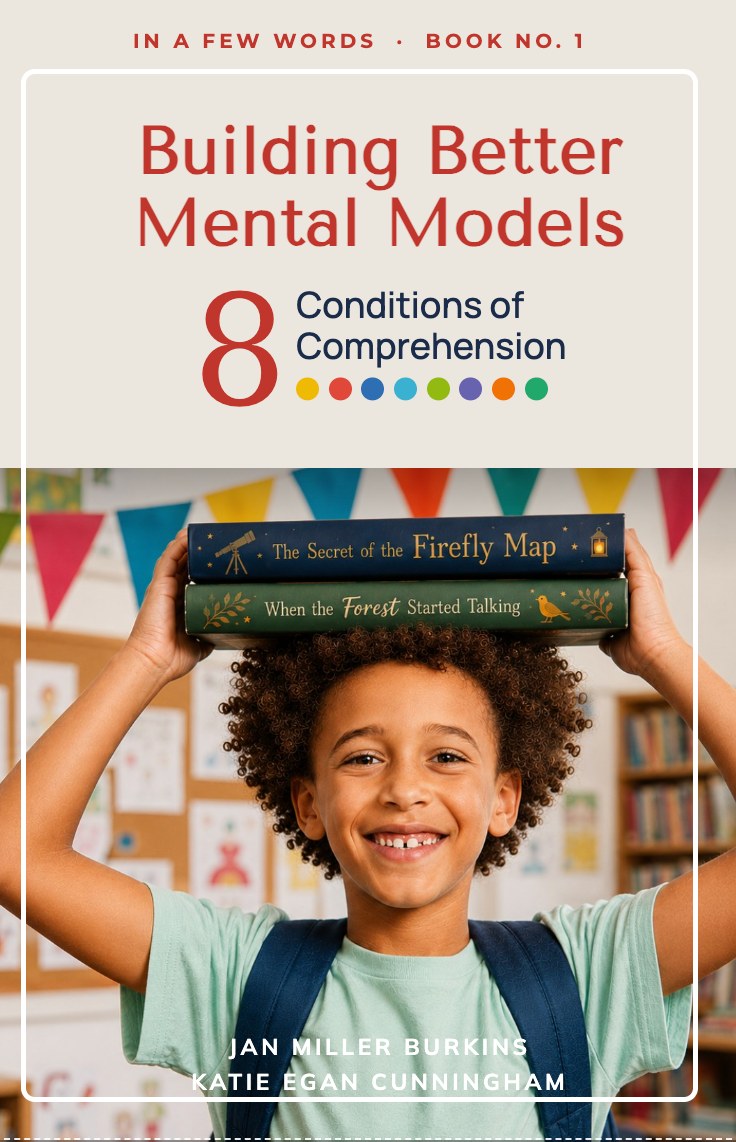
 Get an email each time new content is added →
From the author
Co-author of the bestselling Shifting the Balance series, written with Kari Yates and Katie Egan Cunningham, practical guidance for bringing the science of reading into K‑5 classrooms.
Visit The Six Shifts →